
March 27, 2026
Things I Learned This Week About Religion
A Concern. If the people of Iran don’t rise up, we will lose the war. Why? Because reason and logic are nothing in the face of martyrdom. Will Iran agree to no nukes? It would be seen as a betrayal of God to do so. We aren’t dealing with a reasonable or rational group of people, but rather a group of religious fanatics, and as we have seen in our country, compromise is not possible. There is another school of thought that submitting to foreign pressure, injustice or humiliation is culturally unacceptable, and since Islam requires resisting oppression as a core principle, the idea of “resisting” is deeply embedded in both religious and cultural norms. So, the ideas that Iran will come to its senses, see the light or fully understand its situation is naive. Just as with Bush’s lack of understanding of Middle East power dynamics, our expectations of how a religious theocracy, run by religious fanatics, would respond to external demands also seem naive. What would betray Allah? Abandoning the defense of itself or other Muslims, or accepting domination by a non-Muslim power. Good luck to us.
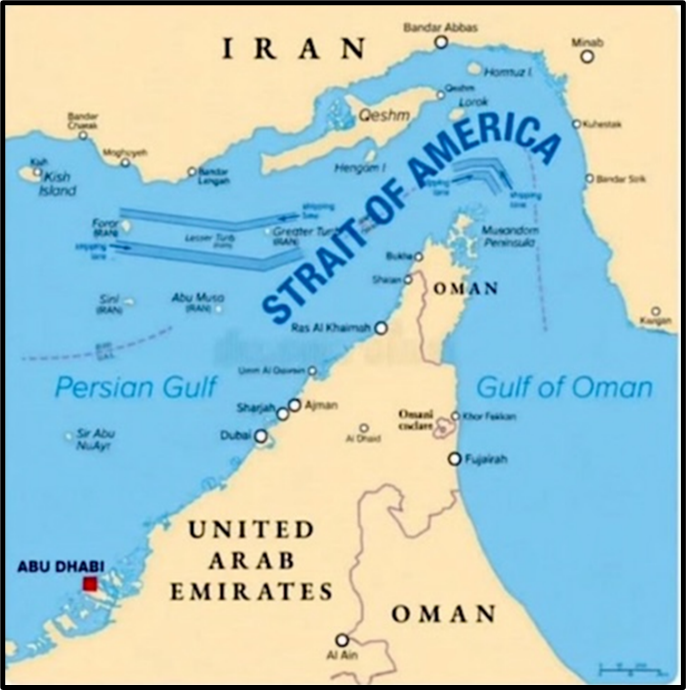
News Datum for Oil. One headline and budgets are likely to move higher. “It will take time to recover from Middle East production hit,” Chevron CEO says. You just raised the datum for crude oil prices. Before the Iranian conflict, oil was hovering around $65, and it was assumed that it included a roughly five dollar risk premium. The market had been assuming that once the Strait opens, things would return to where they were before the conflict, with global crude markets slightly oversupplied. Not anymore, or at least not to the same extent. Either way, both scenarios push prices higher. We have observed over the last four weeks that no U.S. onshore oil companies, and really no companies we’ve seen at all, have made budget announcements indicating higher spending due to higher oil prices. The assumption was simple: the conflict ends, the Strait opens and everything goes back to where it was. That no longer seems to hold. At first, oil facilities were off-limits. When we bombed Kharg Island, we were deliberate in targeting only military installations. Then Israel hit Ras Laffan, and the gloves came off. After Trump said that within 48 hours he would target the electricity grid if the Strait did not open, Israel proceeded to bomb an Iranian power plant. I am not a fan of attacking Iranian power infrastructure, as the population will need it once conditions stabilize, though we have no clear sense of when that might be. There may be no shortage of armchair quarterbacks, but it would not be surprising to see, over the next month, at least some domestic E&Ps begin to discuss higher spending plans for the remaining three quarters of the year than previously anticipated. This is how markets work. Chevron, Exxon and Shell are all being negatively impacted by the closure of the Strait, and it now appears that supply disruptions will persist as reconstruction takes place. Even if the Strait reopens soon, and even if damage to gulf oil production facilities is limited, oil will likely continue to carry a premium above pre-conflict levels, which were already higher than expected at the beginning of the year and had begun to support increased spending.
Never Say Die. Liberty Energy has been transitioning from an oilfield services company to an energy and power solutions business. It was one of the first OFS companies to see the potential of power generation within the group and act on it. They have investments across areas ranging from reciprocating engines to nuclear. This week, the company announced that a previously expected project had been cancelled. It happens. The 330 megawatt deal was intended to power a Texas-based data center, but the project was modified and delayed, leading to the contract being terminated. Without missing a beat, the company upsized a convertible senior notes deal to $475 million, due 2032, at a 30% premium to the stock price (conversion at $37.44).

Lease Sale. National Ocean Industries Association (NOIA) President Erik Milito issued the following statement after the Department of the Interior concluded the Big Beautiful Gulf 2 offshore oil and gas lease sale:
“Building on December's landmark Big Beautiful Gulf 1 Lease Sale, America’s offshore energy industry continues to reinforce its commitment to investment in U.S. energy, economic and national security. NOIA applauds President Trump, Secretary Burgum and Congress for rebuilding the predictable leasing cadence that American energy dominance requires. Continued access to the oil and gas resources of the Gulf of America is a national security imperative. Volatile oil markets and escalating geopolitical tensions, including the ongoing conflict with Iran, are a reminder that American energy is a prerequisite for American strength and stability. The production coming out of the Gulf of America today is the direct result of lease decisions made years ago. The lease sale held today will lead to production that will protect us tomorrow. More domestic production means less dependence on foreign oil, fewer leverage points for our adversaries and a stronger America at exactly the moment the world most needs American leadership.”
“Lease sales like this one drive investment across all 50 states, support hundreds of thousands of good-paying jobs and deliver massive revenues for American taxpayers in support of our national parks, conservation efforts, coastal restoration and urban recreation programs. Barrels produced in the Gulf of America carry a far lower carbon intensity than foreign imports. American energy keeps allies supplied and adversaries in check. In uncertain times, American strength is essential. Offshore energy is a cornerstone of that strength, and every lease sale such as the Big Beautiful Gulf 2 Lease Sale is a long-term strategic investment in American dominance. The world is stronger, safer and more secure with American energy leading the way.”
The lease sale was the second non-discretionary offshore oil and gas lease sale required under President Trump’s “One Big Beautiful Bill Act.” It included 25 blocks covering approximately 141,000 acres in federal waters, with thirteen companies submitting 38 bids totaling $69,838,782 and $46,976,423 in high bids, and a 12.5% royalty rate for both.
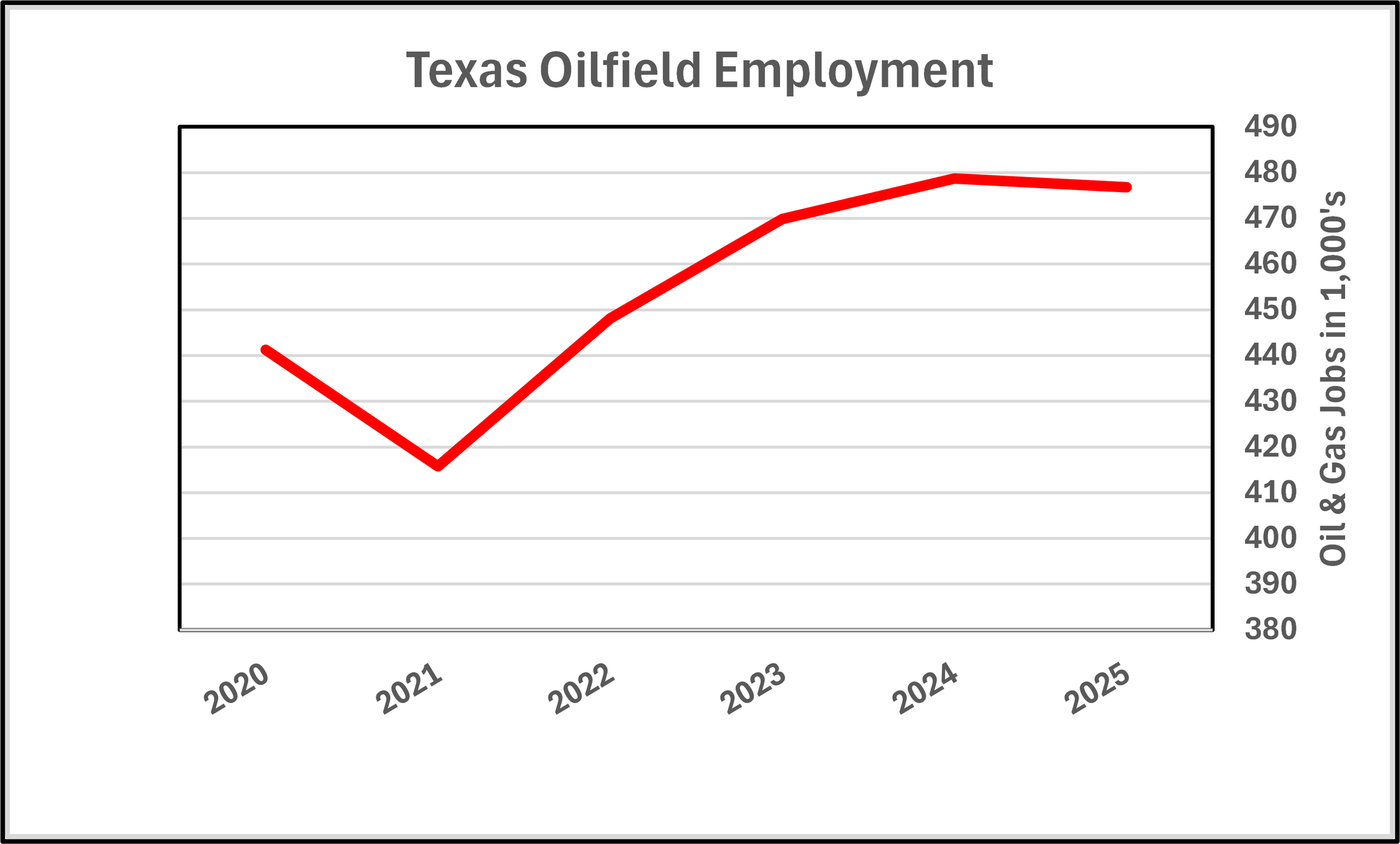
Working Away. Texas is still home to more oil and gas workers than any other state, with 476,777 people working away in the industry every day. We win! TIPRO, the Texas Independent Producers and Royalty Owners Association, put out a report on the topic. On a somewhat related topic, as you read this, Monday marks the start of TIPRO’s Annual Meeting in Houston, but it isn’t until Tuesday that Marshal Adkins, Jeff Bellman and I take the stage. Should be fun. Anyway, when incorporating direct, indirect and included multipliers for oil and gas employment, the industry supported a total of 476,777 jobs in Texas in 2025. Oil and gas jobs in Texas paid an average annual wage of $133,439, which the association said was 74% higher than the average private sector job in the state. The highest average industry wages were in Alaska last year at $150,986, all according to the report. Not a bad place to work if you like money. I wasn’t surprised that Texas ranked first in oil and gas payroll, but I was surprised that, at $64 billion, it was more than 4x the second-ranked state. Even more surprising, that state was California. Louisiana came in third at $10 billion. And the importance of oil and gas to the state of Texas? It is estimated that the direct Gross Regional Product for the industry was $385 billion, with “the Texas oil and natural gas industry supporting 36% of the Texas economy.” We are important.
Soapbox. Elections would be much more efficient if they were coordinated on a federal basis with one point of accountability instead of 50. But that’s not what the founders wrote in the constitution. So if you're on a jihad to make voting more efficient, you have to approach it on a state-by-state basis. I don't like or agree with much of the liberal rhetoric around the Safe Voting Act, and I have to admit I don't support it. I do believe in voter ID. You should have to prove who you are when you vote. But requiring people to prove it on the spot with only a limited and rarely used set of documents is insensible to me. If I have to bring my passport, my birth certificate, and, if applicable, a marriage certificate, along with a photo ID just to vote, that makes it too difficult. The Real ID idea has worked pretty well and, as I understand it, is now required to fly. That seems like a much better solution. If you're one of the few people without a Real ID and typically fly with a passport, then voting with a passport shouldn't be an issue. But as the act is currently written, I'm not a fan. While the sound bites are positive, the details tell a very different story, in my opinion.
Timing is Everything. HMH was formed by the 50/50 merger of Baker Hughes' Subsea and Surface Drilling Systems business and Akastor ASA's subsidiary, MHWirth, in 2021, and in the summer of 2024 filed for its IPO. Needless to say, the market has not been very supportive of oilfield services equipment stocks over the last two years. A few water and a few power-related deals have priced, but it is a narrow field. So now the combined company, HMH, is going to try to go public again. We have followed HMH over the years, as many of the managers are well known to us from previous roles. The company has had its issues, though it has some very recognizable brand names such as Hydril, VetcoGray, Maritime Hydraulics and Wirth. Texas-based HMH provides drilling equipment and aftermarket services for offshore and onshore drilling, subsea and onshore mining and construction. But clearly, either the market or the company’s performance has improved. Maybe both. Still, a $950 million valuation seems a little ambitious, with plans to raise about $230 million at that valuation.

Golf Question. What does the first ball you tee up in the morning have in common with the good-looking girl driving the drinks cart? Neither one is going home with you.
Perspective. It amazes me where we've gotten as a society today. The president offers to help ease congestion at airports around the country by moving some people from one department to another. Airports were short-staffed. Congress hasn't figured out a way to pay TSA yet. Elon Musk offered to cover TSA salaries, but nobody will mention that on television for fear of making him look good. The headlines actually said Trump “threatens” to provide ICE agents to airports. I thought “offered” was a much better term. What world do we live in where someone offers to divert resources to help the general good and is vilified for it? The typical news channels went crazy analyzing every aspect from the TSA handbook. After listening to a couple of these shows, you would think all TSA agents have PhDs related to their jobs and immigration officers have no training in anything other than using force. How horrible is it to live in such a cynical world. Anyone who makes my travel life easier? I'm a fan.
PPHB U.S. Energy Market Highlights:
Commodity Prices: WTI crude oil is currently $94.48 per barrel (down ~3.8% week-over-week) and natural gas is $2.93 per MMBtu (down ~4.4% week-over-week).
Crude Oil Production: U.S. crude oil production is currently ~13.7 MM BOPD (up ~0.6% year-over-year).
Crude Oil Inventories: U.S. crude oil inventories increased by ~0.7 million barrels week-over-week vs. an estimated decrease of ~1.3 million barrels.
Frac Spread Count: There are currently 164 frac spreads operating in the U.S. (decrease of 8 spreads week-over-week).
Onshore Drilling Rig Count: There are currently 552 drilling rigs operating in the U.S. (decrease of 1 drilling rig week-over-week).
Sell-Side Analyst View of OFS. What impact is the conflict in Iran having on the OFS industry in the region? We got this opinion from one of the smart ones. “We preliminarily estimate the 1Q EBITDA impact for WFRD/BKR/HAL to be -9% / -7% / -5%. With a competitor energy conference this week, we would not be surprised if more energy services companies guide down 1Q estimates. Applying a comparable revenue reduction, adjusted for geographic differences, for one month of Middle East disruptions (which works out to -1% to -3%) and assuming 75% decremental margins (up from our previous assumption of 60%, but below the ~90% in SLB’s guidance), implies 1Q EBITDA for WFRD of $210MM (-9% vs. the $232MM consensus), for BKR approximately $985MM (-7% vs. the $1.06B consensus), and for HAL approximately $900MM (-5% vs. the $952MM consensus).”
How to Play? I think AI is going to be very impactful on the oil and gas industry, especially on the geoscience side. The problem is it could lead to a lot of geologists, geophysicists and paraphysicists being out of a job. When people say that technology advances employment, I think of what Landmark Graphics did to us geophysicists. One Landmark station could out-map a human “picker” by a factor of 20x. PhD’s were driving taxis. Industry success rates went up, dry holes went down, the economic benefit to the industry was huge to the industry and employment dropped like a stone. So when I saw that SLB is expanding its technology collaboration with Nvidia, I had to look at it. The two companies first met each other 18 years ago, when Nvidia’s computing capability was used to improve imaging software, enhancing reservoir visualization and seismic interpretations. They came back 16 years later, expanding the collaboration into the development of generative AI models. SLB will serve as the modular design partner for Nvidia’s DSX data centers, using offsite construction to reduce costs, labor constraints and lead times, developing what they call an “AI Factory for Energy.” The agents would run on SLB's digital platforms to help energy companies use AI for their data and operations. “Building AI factory infrastructure and domain models is needed to turn massive amounts of energy data into actionable insights and accelerate more efficient and sustainable energy systems,” according to Nvidia. But what does that really mean? Nvidia provides the AI chips, software and computing platforms, while SLB provides energy data, domain expertise and industry workflows to build an integrated model from subsurface geology to drilling to production to power systems. Why? Because SLB is repositioning itself from an oilfield services company to a digital, AI and infrastructure company. Everyone is transitioning, somehow.
Snippets.
Compared to 2024, the term “DEI” fell 98% across Fortune 100 communications according to Gravity Research.
Over 400 colleges and universities have ended or rebranded their DEI programs.
In 2022, 20% of adults under the age of 24 identified as lesbian, gay or bisexual according to the U.S. CDC and prevention survey. According to one source, it was down to 15% in 2025.
Automobile companies have in aggregate written down more than $70 billion in value attributed to electric vehicles and support.
Question. Gadfly Greta Thunberg is now berating Trump for not sending oil to Cuba. So now she’s for fossil fuels?
Freeze Baby Freeze. The DOE has given approval for a few U.S. LNG facilities to boost output due to the constraints in the market due to the Iran Conflict and accelerating the opening of others.
Venture Global to boost exports from Plaquemines LNG by 13%.
Cheniere Energy's Corpus Christi LNG project received approval for expanded exports to non-FTA countries.
Alaska LNG has signed a letter of intent with TotalEnergies to supply 2 million tpy of LNG for 20 years, pending project approval.
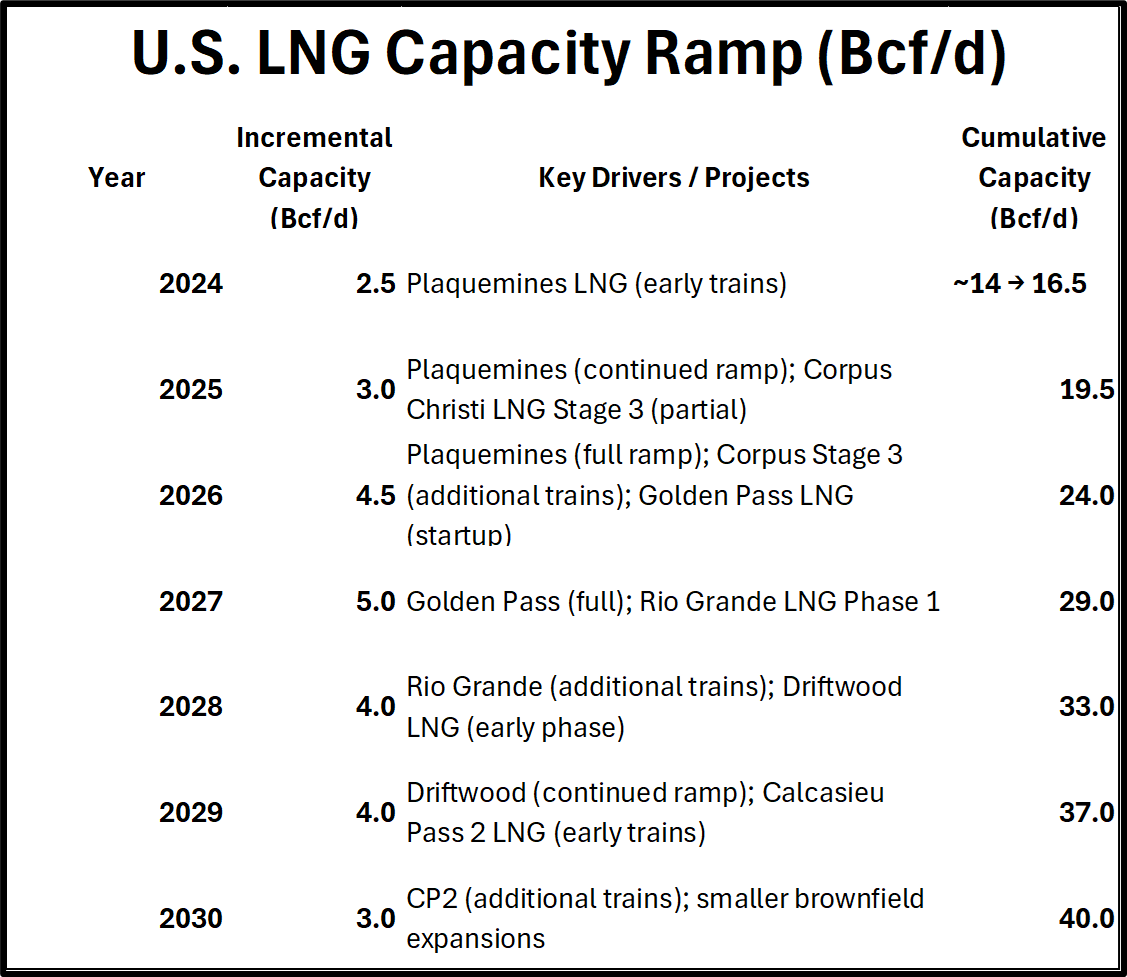
Increased throughput at these LNG facilities and the ones under construction are accelerating their timelines as much as possible. There is line of sight to 40 Bcf per day of LNG export capacity by 2031. We were at 16.5 Bcf per day at the end of 2024, and 19.5 Bcf per day at the end of last year.
Making Sense. I’m starting to understand why Yahoo has been losing market share. The paper hadn’t come yet, so I clicked on Yahoo and I hit the button for the latest news on a Sunday morning. There was no mention of Iran in the first 20 stories, and it was the 16th story that finally mentioned oil and it was titled “How to Make Money if Oil Goes Above $100”. But it was just all the latest gossip on who is in a bikini and who shouldn’t be. With everything going on in the world today and some 50% of people getting their news off the internet, this is what comes up as the latest world news. We wonder sometimes how we end up with the elected officials we do. I guess one good part is that its popularity is waning but geez, this is the education of the masses? We are in deep trouble folks.

Silver Lining? AI will make work more fun. One study found that, “workers moved faster, took on broader tasks, and extended their hours into evenings and early mornings. Nobody told them to. These workers did more because AI made it, in the words of the researchers, “intrinsically rewarding.’” — Gautam Mukunda, Bloomberg Opinion.
Cigars and Rum? We have been writing about the situation in Cuba for sometime. Cuba lost part of its lifeline at the start of the Russia-Ukraine War since Russia provided oil and fuels to Cuba, along with a fairly decent support effort in general. When the Ukraine War started, that went away. Next was Venezuela. That country had been supplying Cuba with oil for sometime. Mexico has sold oil to Cuba. But it’s much more of a commercial operation in Cuba, who has no money right now. Cuba produces about 50,000 barrels a day, but demand is about 110,000 barrels a day. The math doesn’t work. We all know about the rolling blackouts, and then, earlier this month, the entire island went dark. Then Cuba came out and said Cuban exiles and their descendants can invest in Cuba and bring in their own fuel. This has been a desire of the Cuban exiles in Florida for some time. But the latest is that our Secretary of State has stuck a fork in it. He said the changes don’t go far enough, and that all proposals were moot until Cuba put “new people in charge”. That’s fairly definitive. Cuba is out of alternatives. Protest have been put down so thoroughly for decades that there really isn’t a shadow party representing the people. The military makes and holds all the money. They’ve already said they won’t cede power until they’re granted amnesty, which speaks volumes on itself. Trump told reporters on March 16th that he believed he’d have “the honor of taking Cuba”.

It’s Oklahoma. The oil business is as much a part of the state as tornados and Indians. And we realize this could never happen in California or Massachusetts. But the governor of Oklahoma just picked the chairman of Williams Companies, a $90 billion energy infrastructure company, for the U.S. Senate, filling the seat vacated by Senator Mullen who just got picked to lead Homeland Security. The chairman, Alan Armstrong, will be focused on permitting reform, one of our industry’s hottest topic in DC for the past few years, and he is in line with President Trump’s energy objectives. But he has to move quickly. Elections are in November, and Oklahoma state law prohibits Senate appointees from running for the seat in a subsequent election. Seven months to make a difference. But what a great person for the job!
More For Us! China, a country tightly controlled by its leader, is doing a dry January. And February. And March. It seems as though the government has decided that festive drinking is not a good thing and unbecoming for a good Chinese communist. Red wine has taken the brunt of the drop, with consumption down 25% in 2023, down 5% in 2024 and still heading south today. Red wine sales are down more than 60% in five years. Several years ago, the Chinese took aim at many of the French wine Châteaus. Many old families scoffed at the idea, but the size of the money put up by the Chinese was irresistible, and, for a period of time, the Chinese drove up the price of French wine dramatically. Between 2008 and 2010, the Chinese bought over 3% of Bordeaux and 150 to 200 estates were sold. The silver lining? Since 2022, top French Bordeaux’s were down 24%. In the past, drinking was part of their business culture. And top red wines were status: For weddings, parties and meetings. But in China, the government owns at least part of every company. So, when it came down from Monai that drinking at company or government functions was no longer acceptable, consumption dropped like a rock. The fact that the real estate market in China has crashed badly and the economy has been struggling for the last couple of years would indicate some slow down, including excessive spending on red wine apparently. So, now we have vines being ripped up around the world, there is a glut of red wine. The Argentina wine prices have been hit worse, with 1,100 wineries shut down. There, consumption is the issue. Cultural tastes change, and younger people are moving to beer and spirits. Red wines are typically more expensive, and that has added to the problem with the country that is still experiencing economic problems. It is sad to see, but a really good time to restock that cellar!

Foreshadowing. The co-founder of AI company Anthropic was speaking the other day about the impact of AI on the workforce. He said that AI had the potential to replace half of entry-level white collar workers. It’s been one of our biggest fears: The social aspects of AI. You’re further separated from people in the country by economy and job. But he makes an interesting observation about the future. He said within five years, “cancer is cured and the economy grows about 10% a year. The budget is balanced and 20% of the people don’t have jobs.” Several other AI CEOs have been promoting the idea of the universal basic income, mainly because they believe it’ll be needed for those 20% of the people without jobs in five years. We’ve already seen thousands of people let go by the large tech companies because they’re accelerating their implementation of AI. If that isn’t foreshadowing, I don’t know what is. And technology always seems to move faster these days rather than slower. In five years, while having no fear of cancer and seeing a robust economy, I’ll have my robot running around the house keeping things in order so I can spend all of my time watching short videos on my computer. If that’s the future, I may just pass.
Corrected. The other week, we wrote the following: “The smaller and thus faster to deploy turbines are only about 65% booked for 2028 and only 33% booked for 2029. The very large turbines, by GE Vernova and others are 90% booked through 2028, but are mainly ordered for utility use. These technology companies still care about emissions and lowering them over time, which makes ‘behind the meter’ projects difficult since the emissions trail is direct if the technology company owns the data centers. Third party? Maybe not. Five nines. Reliability has to be 99.999%. That is five minutes a year. That too favors the grid.” To me, it is still a toss-up, with the most likely answer continuing to be “all of the above”. We have said that finding a turbine somewhere is like finding a 1963 Corvette, stored in a garage and forgotten. Near term, that is still the case. Over the next several years? The market is still developing.” A very good friend corrected me and I very much appreciate the education. Thanks Jimmy.
Not entirely correct. Most of the small reciprocating engines have SCR (Selective Catalytic Reduction) and can actually be built in non-attainment zones.
Turbines still do not work for AI data centers without batteries. The load swings too much and the turbines will trip.
The industry is learning, but still has a long way to go.
I still put my money on small behind-the-meter turbines until grid connection replaces it sometime after 2030.
Changing the Game. We have not been the biggest advocate for battery storage for most power-driven projects. The limited amount of storage was not seen as sufficient to bridge the loss of power from the primary energy source. Two hours of battery time is great, but if the wind doesn’t blow or the sun doesn’t shine in time, you are out of luck, unless the technology evolves. Form Energy has developed an iron-air battery that costs one-tenth that of a traditional storage battery and it can store enough energy to last 100 hours. That changes the game. They aren’t as efficient but if you put 100 units of charge into an iron-air battery, you get 50 to 70 points of charge back when you use it. A lithium-ion battery with the same input would release 90 to 95 points of charge. But the materials to make the battery are significantly less, lowering the cost so much that even with that inefficiency, it makes great economic sense. When an iron-air battery discharges, iron metal combines with oxygen, forming iron oxide (rust), releasing electrons. This flow of electrons provides energy in the form of electricity. On the flip side, when excess electricity is available, for example, from a wind turbine or a solar panel, that electricity drives the reverse chemical reaction, charging the battery. Rust is converted back into iron metal, releasing oxygen. The biggest benefit? I can use renewables to power data centers. While the wind doesn’t always blow and the sun doesn’t always shine, 100 hours of bridge time for batteries changes the game.
The Price of High Oil Prices? Among other moves, schools have closed in Pakistan and Bangladesh, a 4-day work week has been implemented in the Philippines, and restaurants have closed in India. In the latter’s case, due to a lack of LNG for restaurant cooking fuel.
A Follow-Up. We wrote last week about Jim Flores, one of the luckiest men in the world, and the huge lifeline tossed to his offshore California venture that had been plagued with issues, most of which now seem moot. Energy Secretary Chris Wright acted on an executive order from President Trump to allow Sable Offshore (NYSE:SOC) to restart its Santa Ynez pipeline system in California. It was reported this week that Chevron plans to buy 20K bbl of crude per day from Sable's platforms once they start producing. It is estimated that Sable could quickly start pumping 45K to 55K bbls per day of crude. Midas, the man with the golden touch.
Any and all comments, arguments and rebuttals are welcome!
In addition to my association with PPHB, I serve on three private company boards. Merit Advisors is a property valuation company and I have long been a fan of optimizing how a business is run, not just the tools we make. Merit is in the business of savings companies’ money, actual cash, by doing a much more in-depth and realistic view of equipment and reserve valuations and I am very impressed with their work. I am also on the advisory board of Preng & Associates, a leading executive search boutique that specializes in all things related to Energy & Power.
I serve on the Advisory board of the Energy Workforce & Technology Council (formerly PESA), the National Ocean Industries Association (NOIA), and the Maguire Energy Institute at SMU my alma mater.
jim
214-755-3914 | james.wicklund@pphb.com
Leveraging deep industry knowledge and experience, since its formation in 2003, PPHB has advised on more than 180 transactions exceeding $11 Billion in total value. PPHB advises in mergers & acquisitions, both sell-side and buy-side, raises institutional private equity and debt and offers debt and restructuring advisory services. The firm provides clients with proven investment banking partners, committed to the industry, and committed to success.
