
May 8, 2026
Things I Learned This Week About Traveling
Steady As She Goes. The rush of earnings is slowing down. Many companies hit expectations, but with the market where it is so far this year, companies have been very proactive in making sure they don’t overpromise in the current environment. It is also now possible to be optimistic about the next year or two than it would have been two months ago. The crisis continues, and capital budgets tend to get sidelined in times of war, but the U.S. business environment is seeing a bit more activity and the Middle East should boom once the Strait finally opens, whenever that may be. No one is getting stupid. Capital discipline is being seen across the board. Caution and technology are hot buzzwords. While today is not really much better than yesterday, tomorrow should be even better, so things are headed in the right direction.
King Tut. My young son, Henry, has graduated from Colorado with a BBS in Finance and Accounting. Smart, hard-working kid. He is currently looking for a leadership training program. Past the pitch, Henry got to pick his graduation trip, and we are leaving this weekend for Egypt. I have been before, but it has been a while. It is too unique of an opportunity to pass up. As a result, I will not be writing next week, but I will publish a piece from 2018 to show how perspectives have changed. Wish me luck.
Economics. The market has gotten optimistic that a deal will get done with Iran. Before you start celebrating, I have seen that headline 20 times in the last 60 days. The Strait open? Completely open, with no drama or issues? I am not so sure. But when I think about the head of the UN and the Prime Minister of the UK telling financial companies to stop financing crude oil and natural gas development projects, I wonder if they still think that way. We have gone from oil being an afterthought 3-4 years ago to it becoming one of the most critical commodities on the planet. “Oil is going away, we do not need it, is so last century.” Just Stop Oil quit protesting because they claimed their point was made. Really? Wind, solar and batteries. Five stars. The oil and gas business? You may as well have called it the greed-and-evil business. Now though? Can I please have some more? Simple economics. Supply goes down, demand continues to rise, few economic substitutes have been found, so prices go up and possibly high enough to cause a global recession. And the alternative? Drill and produce more.

Dealing Cards. The rumor was that Expro was the likely buyer of Helix, with long-time CEO Owen Kratz retiring. Instead, Helix is merging with private offshore boat company Hornbeck, which in some ways is almost a reverse merger, since Hornbeck was considering an IPO. Todd Hornbeck will be the CEO going forward. While that combination percolates, it was announced that another private Louisiana family boat company, Chouest, was buying all of the shallow water abandonment business and assets in the Gulf from Helix for $107.5 million. It gets talked about and proposed often in banking, but two companies merging and then selling off the unwanted assets of one company before the deal closes is a rarity. A banker’s dream.
Gaining Steam. Slowly. The consensus two months ago called for a weakening of activity, at least through mid-year and then hope for a better second half. Then the bombs hit. For the first month of the conflict, while the oil price for the prompt month soared, the back end of the curve didn’t move much at all. Neither did spending. The majors, responsible for 20%+ of activity, normally don’t change capital budgets during the year. That takes some volatility out of the market. The large independents are also demonstrating significant capital discipline, in part to help attract buyers. But now, after two months, the back end of the oil price curve is ~$7-$9 higher than it was, which is the signal to increase spending with greater confidence and at a higher level to hedge. With inventories being heavily drawn and delivery still very limited due to the Strait being closed, there is also an underlying motive to increase production wherever possible, and quickly. Diamondback and Conoco raised their budgets. EOG, Exxon and Oxy kept their budgets unchanged. Chinks in the armor if prices stay high.
Keeping Up With the Jones. It looks like the Jones Act may very well be on its way out on a more permanent basis. The original suspension of the Jones Act was for 60 days, then it was extended by another 90 days and it is now being considered a success. Most of the transportation has been in crude oil and gasoline blend stock, typically in volumes around 300,000 barrels. I have many friends in the boat and boatbuilding business, and I do understand the benefits of the Jones Act, but it appears that the reasons the act was initially instituted may no longer be relevant today. The Jones Act was passed in 1920, right after World War I, when the U.S. didn’t have enough ships or trained men to support the needs of the war. The country had to rely on foreign vessels, and that was considered a national security issue. Protectionism. The law requires that any cargo shipped between U.S. ports must be carried on ships that are: 1) built in the U.S., 2) owned by U.S. companies, 3) crewed by U.S. citizens and 4) carrying the U.S. flag. It made sense at the time, but the U.S. doesn’t really build ships anymore, as they cost 4x-5x more than ships built in South Korea or Singaporean yards. That has left about 100 Jones Act-compliant vessels, and none capable of moving LNG. It is a global market, as demonstrated by oil prices, and competition is generally a good thing. I would expect the suspension to become permanent.

Tripped Over. “Growing up is f***ing hard. You get your heart broken with your first crush. You get adults pressuring you with endless questions about what you want to do when you grow up, even though you can’t think beyond lunch. You’re confused about where you fit in in life. You have to study and get good grades, but not do it too much or too well, or your classmates start hating on you. You cringe at everything your parents do, but woe betide anyone else who says a bad word about them. You argue with your parents, but you also need to assert yourself and don’t know how to do it without falling out with them. You do not yet have exactly the right words for the things you want to say, but boy do you need to say them. All while one part of you still wants to play in the sandpit, and another part of you wants to be treated like a grown-up. Give her a break. And give all young people a break, for that matter.” – Lessons learned.
Back Story. Several years ago, I wrote about the expansion of the Panama Canal. Many economists were saying that it would be one of the best investments and most impactful infrastructure projects seen in decades. The expansion took place 10 years ago. There are a couple of things I learned from it. The expansion of the canal allowed LNG to transit to Asia, essentially enabling the U.S. Gulf Coast LNG industry to flourish. Today, roughly 25% of U.S. LNG exports go to Asia, with most of that volume moving through the canal. What did I not know was that the canal is water dependent. Now you’re probably asking yourself, what does that mean? I did not realize that the Panama Canal depends on rainfall and a freshwater lake. If rainfall levels are too low, some ships, and all LNG tankers, can’t transit and instead have to reroute around Africa, adding significant time and cost. And emissions, which still matter. At times, the canal has even been closed to LNG carriers for a month. All of this is part of the impact of the canal expansion, whose revenues have doubled, while its Chinese-owned ports of Balboa and Cristobal have become poster children of U.S.-Chinese relations. Little things we usually take for granted, and something I learned this week.
A Car Comeback. China has built electric vehicles that are good-looking, packed with every tech bell and whistle and selling for around $30,000. They are trying to flood global markets, including the U.S., before Detroit catches up. Considering that most of the cars I see in airport parking lots are foreign-made, while most trucks and SUVs are U.S.-made, American carmakers have largely made their money on the latter two categories, with U.S.-made cars often relegated to fleet and rental use. But this is an era of aggressive thinking and new ideas. Ford expects to release its electric truck, loaded with all the bells and whistles, next year for around $30,000. Better late than never. It is worth remembering that there has been a 25% tariff on imported pickup trucks and light-duty trucks since 1964, which has helped drive the profitability of those products lines for U.S. carmakers. But this time, the motivation is different. It is about staying relevant. I recently bought a Chinese-made golf cart at a price 30%-50% below the cost of a U.S.-made EZ-GO or Club Car, and it came with more technology features than I could have imagined. As we are seeing with oil, the global market is truly global. You can’t win on protectionism alone. It only delays the inevitable unless real change happens.

Legal Backing. In a former life, I was married to a lawyer. She was a trial attorney in federal court representing plaintiffs in asbestos cases and other suits of that nature. I learned overtime that it wasn’t ideology of protecting the downtrodden or injured that drove her and those like her. It was the drive to win. Just win. So, an article caught my eye this week which discussed taxes and trial lawyers. It turns out there’s a loophole in the U.S. tax law that gives complete tax breaks to foreign entities who win settlements in lawsuits. You, me and our attorneys? 25% to 37%. But a European billionaire? Zero. Tax free. But wait, why was the European billionaire suing some U.S. entity? He wasn’t. He is funding the lawyers and the lawsuit. And there are lots of those. It turns out to be a very fast-growing business. The U.S. has over 30% of the world’s lawyers (Only 4% of the population!) and lots of big companies. A target rich environment. Russia, it seems, is one of the major sources of backing. Russian billionaires funding lawsuits against U.S. companies, and they pay no U.S. taxes on any money they make? Wow. That is one of those loopholes that needs to be closed. We are enough of a litigious society as it is that that outside funding cannot be a good thing.
Select Water Solutions. Select beat expectations on both revenue and margins, with Q2 estimates hiking up about 9%, driven by strong water infrastructure and services. Total capital expenditures are estimated to rise by about 10% to $200 to $250 billion.
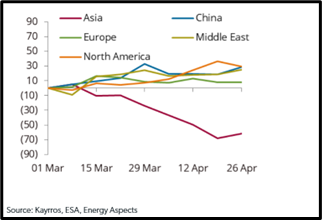
Cumulative Stock Change by Region Since 1 March, mb
Pipes. President Biden killed the Excel pipeline back in 2021, and the industry shifted its logistics to accommodate the new reality, or, in this case, the existing reality of change plans. Now groups are proposing Keystone Light: A 650-mile pipeline that would go from the Canada-Montana border down into Wyoming and pass fairly close by the Bock and Kjell region. What is being proposed is a 1 million barrel a day pipe with 70% of the pipeline plan to be built next to existing infrastructure. Every environmental group is, of course, against the pipeline, which is expected to be completed by early 2029. The U.S. is Canada’s only option for selling oil, and recent tariff and political arguments have made Canada look at other options. The government of Alberta is spearheading an effort to build a 1-million-barrel pipeline to Canada’s West Coast to allow for export to Southeast Asia and around the world. That’s almost a quarter of Canada’s output. The Alberta government estimates that the pipeline would add $31 billion annually to Canada’s GDP. Not much attention gets paid to Canada these days. Kjell’s making a big movement into the Monty Shale, and that should catch some people’s attention. After becoming a company shedding their heavy oil assets, they are now looking at light oil and gas opportunities in Canada more aggressively, with two pipelines proposed that could add another two million barrels of export capacity and half of that into the international markets rather than the captive U.S. market. It becomes all the more attractive. Remember that Canada LNG is under construction on the West Coast and will soon be shipping LNG cargoes out for the first time.
Starting to feel it. The TSA problems at the airport didn’t bother anybody until they had to fly. Nobody paid any attention to gasoline prices until they started to go up. Few people have worried about wars in Ukraine, Russia and Iran disturbing their summer holidays. If ending 50 years of supported terror and oppression isn’t worth paying the same price for gasoline as Californians for a few years, it goes to show that people don’t care about things if they don’t directly touch their lives. A little selfish, but, becoming moot. Your vacation flight back from Paris next month might not have any fuel. The price of being stranded? Of course, it is Paris and not the worst place to be. But Egypt? Turkey? Stranded does not sound so good. But your outbound flight might get cancelled anyway because they don’t have fuel. Not that it is expensive. The price has already doubled in the last 60 days. But we are now talking about absolutely “not available.” Summer vacation is looming. Flying is iffy. Driving is more expensive. Going somewhere on vacation may seem like a simple thought, but if it gets impacted, then you will start to care. But care about the reason and impact as well as the economics.

Nosebleed. Oil is over $100 and natural gas volumes are set to grow by 25% over the next five years. This is the moment we have dreamed of. And the stocks reflect it. The OSX Oilfield Index is up 43% this year. The E&P XOP is up 38%. These are four-month average gains. Some are much higher. And oil prices could go higher. But that would mean the Strait of Hormuz is still closed, so a global recession is a potential issue. We all know the natural gas demand growth drivers, but the price is only $2.66, even with the known growth. You are starting to see analysts start to downgrade ratings because they can’t get their estimates any higher and valuation multiples have already run. Walking on eggshells?
Told You. We said a couple of months ago that the issues in the Iran Conflict make barrels of oil that don’t go through the Strait of Hormuz more valuable. One of the more glaring things we saw was an acceleration of licensing interest in Venezuela. All the oil companies started out slow, rolling any capital commitments to invest out of the way for just a technical review before budgets were made. BP just signed a deal for offshore gas, and other major oil companies, including Exxon and Conoco, have changed their tune and are now beginning to send technical teams. We continue to believe that activity in Venezuela will move faster now after the Iran Conflict as those barrels gain value by location. Oil exports from Venezuela hit seven-year highs at 1.23 million barrels in April, a 14% sequential increase. We see that much of the export capacity is made up from storage since overall production is still right at one million barrels per day.
Marketplace. I have two groups who have identified conventional fields to “revitalize.” Both are very technically competent. They have locked up projects and are now looking for money. $2.5 to $100 million. None of it is chasing the current price or strip. If anyone has any ideas, please pass them along. Good people. I have another group that is looking for an oil company operating partner for a project in Venezuela, approved under the new laws and rules. Looking for oil and gas money though a producing field rather than a huge development is a big ask. I frequently get asked if I can help someone raise capital. The answer is almost always no. But it’s like helping someone find a job. If you know they are good, you want to help.
OPEC+ Rides to the Rescue? First The UAE announced its intention to leave OPEC, and as one of the larger producers and one with additional capacity that can be quickly put into the market, they carry inordinate weight. But the entire group has decided to help out and increase production. Think of this. They are not gouging consumers but rather aiding them by adding capacity to the market with the idea of lowering oil prices. The seven OPEC+ countries had announced earlier they would put another 190,000 barrels per day into the market in June.
Countries Increasing Production (and by how much):
Saudi Arabia: +62,000 bpd
Russia: +62,000 bpd
Iraq: +26,000 bpd
Kuwait: +16,000 bpd
Kazakhstan: +10,000 bpd
Algeria: +6,000 bpd
Oman: +5,000 bpd
After this increase, approximate June levels of production are:
Saudi Arabia: ~10.3 million bpd
Russia: ~9.8 million bpd
Iraq: ~4.35 million bpd
Others scale accordingly
Fairness? There is more to global fairness and humanity than gasoline prices. Initiatives were taken less than just four years ago, accomplishing what seven former U.S. presidents stated they would face and treat as their biggest challenge. Hezbollah, Houthi rebels, Iraqi insurgents made the promise of using nukes on the U.S. and Israel as soon as possible. And we have to pay California gasoline prices to do stop them. There is more to being an American than getting the cheapest gasoline on the planet. What happened to all the people who wanted to get rid of fossil fuels and thought high prices would do it? Crude oil is critical to our way of life. We have found that China, and now Iran, can put their boot on the neck of America, and all we do is complain about the inconvenience. We are spoiled.
PPHB U.S. Energy Market Highlights:
Commodity Prices: WTI crude oil is currently $94.81 per barrel (down ~7.0% week-over-week) and natural gas is $3.02 per MMBtu (up ~8.7% week-over-week).
Crude Oil Production: U.S. crude oil production is currently ~13.6 MM BOPD (up ~1.5% year-over-year).
Frac Spread Count: There are currently 174 frac spreads operating in the U.S. (increase of 5 spreads week-over-week).
Onshore Drilling Rig Count: There are currently 547 drilling rigs operating in the U.S. (increase of 3 drilling rig week-over-week).
Free At Last! Adnoc is declaring its independence. It has been the most aggressive national oil company. Adnoc has invested an estimated $150 billion between now and the end of 2030 into various countries around the world and their oilfield services. A recent speech in DC had an ambassador saying we don’t stand behind the U.S., we stand shoulder to shoulder with them because they lead the way. They want to break out of the old mold of OPEC. Smaller countries cheat. UAE grows production but can’t increase sales due to OPEC+ quotas. After 60 years, they have grown up.
Notable. You know Asia is truly short of crude oil when Japanese television covers the arrival of a single oil tanker from America as a major news story.
Any and all comments, arguments and rebuttals are welcome!
In addition to my association with PPHB, I serve on three private company boards. Merit Advisors is a property valuation company and I have long been a fan of optimizing how a business is run, not just the tools we make. Merit is in the business of savings companies’ money, actual cash, by doing a much more in-depth and realistic view of equipment and reserve valuations and I am very impressed with their work. I am also on the advisory board of Preng & Associates, a leading executive search boutique that specializes in all things related to Energy & Power.
I serve on the Advisory board of the Energy Workforce & Technology Council (formerly PESA), the National Ocean Industries Association (NOIA), and the Maguire Energy Institute at SMU my alma mater.
jim
214-755-3914 | james.wicklund@pphb.com
Leveraging deep industry knowledge and experience, since its formation in 2003, PPHB has advised on more than 180 transactions exceeding $11 Billion in total value. PPHB advises in mergers & acquisitions, both sell-side and buy-side, raises institutional private equity and debt and offers debt and restructuring advisory services. The firm provides clients with proven investment banking partners, committed to the industry, and committed to success.
